
 论文降重
论文降重 免费查重
免费查重- 钛学术文献服务平台 \
- 学术期刊 \
- 基础科学期刊 \
- 化学期刊 \
- 高分子科学(英文版)期刊 \
CO2-based Biodegradable Supramolecular Polymers with Well-tunable Adhesive Properties
CO2-based Biodegradable Supramolecular Polymers with Well-tunable Adhesive Properties
基本信息来源于合作网站,原文需代理用户跳转至来源网站获取
摘要:
Supramolecular adhesives that enable debonding on-demand are of significant research interest for the development of adaptive and smart materials,yet,biodegrable supramolecular adhesives have been rarely exploited.Herein,telechelic,three-armed and four-armed CO2-based polyols with close molecular weights and various CO2 content (or carbonate unite content) have been synthesized via a zinc-cobalt double metal cyanide complex catalyzed ring-opening copolymerization of CO2 and propylene oxide,and further exploited as sustainable and biodegradable building blocks for supramolecular polymers (SMPs) with 2-ureido-4[1H]-pyrimidinone (UPy) motifs.Notably,the orthogonal modulation of the CO2 content and the topology of CO2-based polyols provide a unique opportunity to fine-tune the surface energy as well as the cohesive strength of the resulting CO2-based SMPs.Notably,a three-armed SMP with 44% CO2 (3UPy-CO2-44%) can well balance the trade-off between surface energy and cohesive strength,therefore bestowing a high adhesive strength of 7.5 and 9.7 MPa towards stainless steel and wood substrates respectively by testing the corresponding single lap joints.Moreover,the light-responsive adhesion property of 3UPy-CO2-44%has been demonstrated exemplarily by blending with a UV sensitizer.


推荐文章
话语标记语well的语用功能
话语标记语
well
语用功能
动态性
混合熔融Li2CO3-Na2CO3-K2CO3体系表面张力计算
熔融碳酸盐
表面张力
模型
Butler方程
Thermodynamic properties of San Carlos olivine at high temperature and high pressure
San Carlos olivine
Thermodynamic property
Thermal expansion
Heat capacity
Temperature gradient
A combined IR and XRD study of natural well crystalline goethites(α-FeOOH)
Crystallinity
Goethite
IR-spectrometry
X-ray diffraction
XRD rietveld refinement
Characterization
内容分析
关键词云
关键词热度
相关文献总数
(/次)
(/年)
文献信息
| 篇名 | CO2-based Biodegradable Supramolecular Polymers with Well-tunable Adhesive Properties | ||
| 来源期刊 | 高分子科学(英文版) | 学科 | |
| 关键词 | |||
| 年,卷(期) | 2022,(1) | 所属期刊栏目 | RESEARCH ARTICLES |
| 研究方向 | 页码范围 | 47-55 | |
| 页数 | 9页 | 分类号 | |
| 字数 | 语种 | 英文 | |
| DOI | |||
五维指标

引文网络
引文网络
二级参考文献 (0)
共引文献 (0)
参考文献 (0)
节点文献
引证文献 (0)
同被引文献 (0)
二级引证文献 (0)
2022(0)
- 参考文献(0)
- 二级参考文献(0)
- 引证文献(0)
- 二级引证文献(0)
引文网络交叉学科

相关学者/机构
期刊影响力
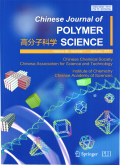
高分子科学(英文版)
主办单位:
中国化学会
中国科学院化学研究所
出版周期:
月刊
ISSN:
0256-7679
CN:
11-2015/O6
开本:
16开
出版地:
北京市中关村一街2号化学所院内
邮发代号:
创刊时间:
1983
语种:
eng
出版文献量(篇)
2840
总下载数(次)
0
期刊文献
相关文献
推荐文献


- 期刊分类
- 期刊(年)
- 期刊(期)
- 期刊推荐
力学
化学
地球物理学
地质学
基础科学综合
大学学报
天文学
天文学、地球科学
数学
气象学
海洋学
物理学
生物学
生物科学
自然地理学和测绘学
自然科学总论
自然科学理论与方法
资源科学
非线性科学与系统科学
高分子科学(英文版)2022
高分子科学(英文版)2021
高分子科学(英文版)2020
高分子科学(英文版)2019
高分子科学(英文版)2018
高分子科学(英文版)2017
高分子科学(英文版)2016
高分子科学(英文版)2015
高分子科学(英文版)2014
高分子科学(英文版)2013
高分子科学(英文版)2012
高分子科学(英文版)2011
高分子科学(英文版)2010
高分子科学(英文版)2009
高分子科学(英文版)2008
高分子科学(英文版)2007
高分子科学(英文版)2006
高分子科学(英文版)2005
高分子科学(英文版)2004
高分子科学(英文版)2003
高分子科学(英文版)2002
高分子科学(英文版)2001
高分子科学(英文版)2000
高分子科学(英文版)1999
高分子科学(英文版)1998


